
By TurtlesEgg Editorial Team
Reviewed for editorial clarity by the TurtlesEgg Search Visibility Editorial Review Team
This article is for general informational purposes only and is not legal, financial, or platform-specific ranking advice. Search systems change often, so always validate major recommendations against current platform documentation and your own analytics.

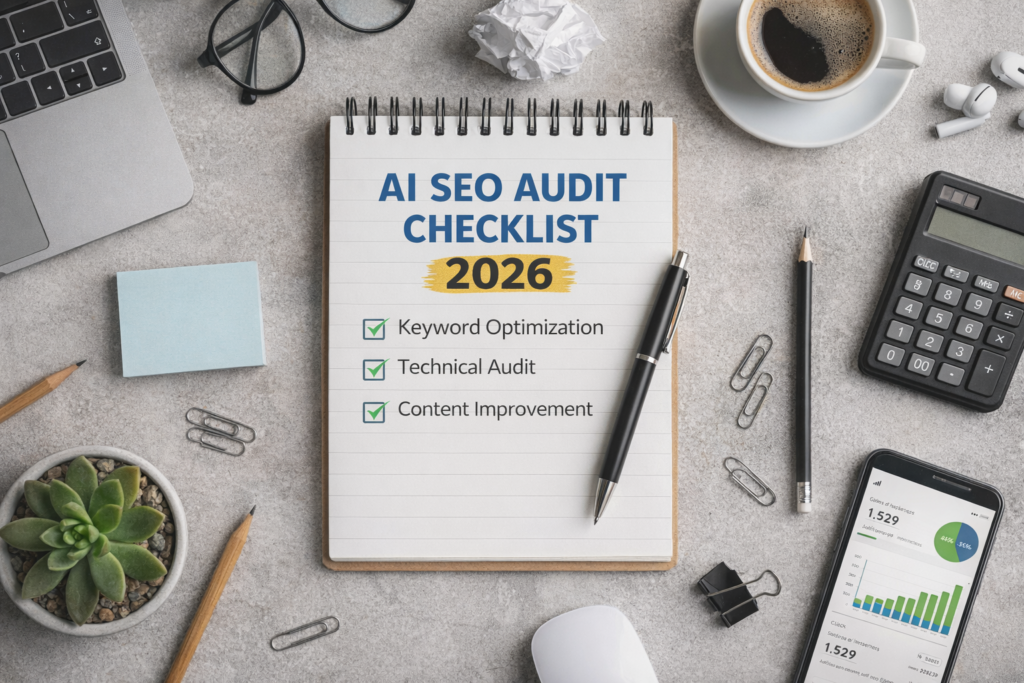
An AI SEO audit checklist helps teams review the pages, systems, and signals that affect search visibility using a faster, more structured workflow. Instead of checking titles, crawlability, Core Web Vitals, internal links, and structured data one by one by hand, AI-assisted workflows can surface issues, group patterns, and speed up first-pass analysis. That makes them useful for marketers, founders, in-house SEO teams, and agencies that need to diagnose pages quickly without skipping foundational work.
Still, AI should not be treated like an automatic ranking engine. Google’s own documentation makes clear that success in Search depends on helpful, reliable, people-first content, crawlability, indexability, and a strong overall page experience, not just a checklist score. See Google’s guidance on helpful, reliable, people-first content, Search Essentials, and the SEO Starter Guide.
This guide explains what an AI SEO audit checklist should include in 2026, how to use AI without letting it replace judgment, which issues matter most first, and how this topic connects to a broader AI SEO checker workflow. If you are also weighing software categories and use cases, our AI SEO tool comparison adds the practical context around how AI-first tools stack up against traditional SEO platforms. And if your growth goals include regional discovery, local commerce visibility, or seller acquisition, the companion guide on boosting local sales with geo-targeted SEO extends this workflow into location-aware strategy. If platform choice is also part of the decision, our guide to the best ecommerce platform for small businesses adds useful context around visibility, retention, and seller fit. If you want a practical tool example while reading, you can also explore WaveAI SEO.
What Is an AI SEO Audit Checklist?
A good checklist keeps teams from missing the basics while AI speeds up the review.
An AI SEO audit checklist is a structured review framework that uses AI-assisted analysis to inspect the most important factors affecting how a page is discovered, understood, and evaluated in search. In practice, that usually means reviewing technical SEO, on-page relevance, internal linking, content quality, user experience signals, and visibility data in one repeatable process.
The best version is not just a giant list of random SEO tasks. It is a prioritization system. It helps you separate hard blockers, such as crawl or indexing problems, from quality improvements, such as weak headings or thin internal link paths. Google explains that Search works through crawling, indexing, and serving results, which is why a useful audit starts with whether Google can access and understand the page at all. See How Google Search Works.
The 6 Layers of an AI SEO Audit
This is the part of the framework people can actually reuse.
The simplest way to make an AI SEO audit repeatable is to organize it into six layers. Each layer answers a different question. If a page fails one of the early layers, later refinements usually matter less until the basics are fixed.
- Crawlability: Can search engines access the page and its important resources?
- Indexability: Is the page eligible to be indexed, and is Google choosing the expected version?
- Relevance: Does the page match the query, answer the topic clearly, and cover the right subtopics?
- Architecture: Does the page sit inside a crawlable, well-linked structure with useful internal paths?
- Experience: Is the page fast, usable, mobile-friendly, and reasonably stable for real visitors?
- Trust Signals: Does the page show accuracy, clarity, sourcing, structured data quality, and overall credibility?
This framework matters because many audits jump straight into wording, metadata, or superficial optimization. In practice, the first two layers decide whether the page can even compete. The middle two layers decide whether the page deserves to surface for the query. The last two layers often influence how well the page holds up against stronger alternatives over time.
If your team needs one thing to remember from this article, it is this: fix lower-layer failures before polishing upper-layer details. A great introduction will not rescue a page with blocked crawling. A clever schema implementation will not compensate for weak relevance or poor internal architecture.

The Core Areas Every AI SEO Audit Should Cover
If the audit misses crawlability, relevance, or user experience, it is incomplete.
1. Crawlability and indexability
Before anything else, confirm that search engines can crawl the page and that the page can be indexed. Google’s documentation notes that robots.txt controls crawler access but is not a reliable way to keep a page out of Google on its own. For exclusion, Google recommends proper indexing controls such as noindex or access restriction where appropriate. See Google’s robots.txt guide and robots meta tag documentation.
- check robots.txt access
- check meta robots or X-Robots-Tag rules
- confirm the page is not accidentally blocked
- review whether the page is actually indexed
- use URL Inspection for page-level diagnostics
Google’s URL Inspection tool is one of the most practical places to validate indexed status, canonical selection, and page-level search information. See URL Inspection tool help.
2. Canonicalization and duplicate control
AI tools are especially useful when duplicate pages appear at scale across collections, parameter URLs, category filters, and near-cloned landing pages. Google defines canonicalization as the process of choosing the representative URL from a set of duplicates, and recommends clear canonical signals when similar versions exist. See Google’s canonicalization overview and canonical URL guidance.
3. On-page relevance and search intent match
An AI audit should review whether the page actually satisfies the intent behind the keyword or query cluster it targets. This includes title quality, heading structure, intro clarity, entity coverage, missing subtopics, weak definitions, and answerability. AI can speed up this review, but human judgment is still needed to decide whether the page is genuinely helpful or just mechanically optimized.
4. Internal links and crawlable site architecture
Internal links matter for both discovery and meaning. Google explicitly says links help Google find pages and understand relevance, and recommends crawlable links with descriptive anchor text. See Google link best practices. A strong AI SEO audit should surface orphaned pages, weak anchor text, thin related-article sections, and missing cluster links.
That is one reason this article should naturally connect back to a broader explanatory resource such as AI SEO Checker: A Comprehensive Guide. The link is not just for SEO. It helps readers move from checklist execution to tool and workflow understanding.
5. Page experience and Core Web Vitals
AI cannot fix performance by itself, but it can help identify patterns. Google recommends achieving good Core Web Vitals and explains that page experience is evaluated alongside other signals. It also notes there is no single page experience signal. See page experience guidance and Core Web Vitals documentation.
- largest contentful paint issues
- interaction latency issues
- layout shift issues
- mobile rendering problems
- HTTPS and intrusive experience problems
6. Structured data and rich result readiness
Structured data helps Google better understand page content and can support rich result eligibility when implemented correctly. AI can help identify missing schema types or inconsistent fields, but implementation still has to follow Google’s structured data rules. See structured data basics, supported structured data types, and general structured data guidelines.
An AI SEO Audit Checklist for 2026
Think of this as the minimum viable checklist before you trust any score.
- Confirm the page is crawlable and indexable.
- Check the canonical URL and duplicates.
- Review title, H1, and heading hierarchy.
- Check whether the introduction answers the page’s core query quickly.
- Review internal links pointing in and out.
- Find thin sections, placeholder text, or duplicated blocks.
- Review structured data eligibility and errors.
- Inspect Core Web Vitals and overall page experience.
- Confirm links are crawlable and anchors are descriptive.
- Use URL Inspection to validate indexing and canonical details.
- Check whether the content is people-first instead of just search-first.
- Compare the page against stronger competing pages for missing coverage.
This is where AI can be genuinely useful. It can summarize gaps, cluster repeated issues across many URLs, and draft prioritized recommendations. But it should not be allowed to hallucinate fixes, invent authority, or rewrite critical business pages without review.
The Triage Rubric: Blocker, High Impact, Medium Impact, Cosmetic
The goal of an audit is not to produce more findings. It is to produce the right order of action.
Blocker
Blockers are problems that can prevent ranking or meaningful visibility entirely. These include accidental noindex tags, crawl blocks, broken canonicals, severe rendering failures, major server errors, or a page that is simply not being indexed when it should be. These are fix-now issues.
High Impact
High-impact issues are not always fatal, but they meaningfully reduce performance. This can include weak intent match, missing internal links from relevant hubs, thin or incomplete coverage, invalid structured data on rich-result pages, or serious Core Web Vitals problems. These usually belong in the first implementation sprint after blockers.
Medium Impact
Medium-impact issues matter, but they usually do not deserve top priority over structural failures. Examples include modest heading improvements, image alt text refinement, partial anchor text cleanup, or small metadata improvements on already-indexed pages that otherwise function correctly.
Cosmetic
Cosmetic issues are polish tasks. These can include minor phrasing changes, non-critical formatting improvements, slight CTA rewrites, or score-driven suggestions that do not materially change discovery, understanding, or page usefulness. Cosmetic work belongs last.
In practice, teams should use this rubric before assigning tickets. If ten fixes are proposed and three are blockers, the blockers should ship before the rest. That sounds obvious, but many SEO workflows still burn time polishing pages that are broken at the crawl or canonical layer.
Method: How to Run an AI SEO Audit Without Letting AI Drive the Whole Process
Use AI for speed, then use judgment for decisions.
Step 1: Start with one URL and one search intent
Pick a specific page and define what it is supposed to rank for or solve. AI audits fail when they try to score everything without clarity on intent. A category page, blog post, tool landing page, and product page should not be audited the same way.
Step 2: Pull search and page diagnostics first
Use Search Console, URL Inspection, crawl data, page performance data, and rendered page review before asking AI for recommendations. AI works best when it is analyzing real diagnostics, not guessing from a URL alone. Google recommends Search Console for debugging indexing and page-level issues. See How to use Search Console and Google’s recrawl guidance.
Step 3: Let AI classify issues by severity
A practical AI workflow is to label issues as blockers, high-impact improvements, medium improvements, or cosmetic fixes. That keeps teams from spending a week tweaking headings on a page that is not even indexable.
Step 4: Rewrite only after diagnosis
Many teams misuse AI by rewriting pages before they have confirmed what is actually wrong. If the issue is canonical confusion, weak internal linking, or blocked crawling, content rewriting may not solve the real problem at all.
Step 5: Validate recommendations against platform guidance
Before you ship major changes, compare them with current guidance from Google Search Central. This matters especially for canonical rules, structured data, crawl controls, and rich result eligibility.

AI SEO Audit vs Traditional Manual SEO Audit
AI is not replacing the audit. It is changing how the first pass gets done.
| Dimension | AI SEO Audit | Traditional Manual SEO Audit |
|---|---|---|
| Speed | Fast at first-pass review and clustering repeated issues | Slower, especially across many URLs |
| Pattern detection | Strong at surfacing repeated defects and content gaps at scale | More limited unless the analyst is working from crawl exports manually |
| Human judgment needed | Still high for prioritization and final decisions | High throughout the process |
| Technical depth | Useful when paired with crawl, rendering, and Search Console data | Can be very deep, but depends on analyst time and tooling |
| Content evaluation | Good for summarizing gaps, intent mismatch, and structure issues | Often stronger for nuance, brand fit, and editorial quality |
| Prioritization | Fast if severity rules are defined well | Usually more deliberate but slower |
| Scalability | Better for large sites, repeated audits, and fast diagnostics | Better for high-touch strategic reviews on smaller sets of pages |
| Best use case | First-pass diagnosis, clustering, and issue triage | Validation, strategy, edge cases, and implementation planning |
The strongest workflow blends both. AI reduces repetitive review time. Human operators still decide what matters, what to fix first, and what aligns with business goals. That is also where tools become useful. A page-level tool such as WaveAI SEO can help teams get an initial view of SEO and AI-search-facing issues quickly, while a broader manual review confirms what deserves action. For readers who want a fuller explanation of how AI SEO checkers fit into this workflow, our companion article on AI SEO checkers goes deeper into tool logic, scoring, and practical usage. Teams that are pairing audit work with platform selection may also find our guide to the best ecommerce platform for small businesses useful when deciding where that work will actually be implemented.
Common Mistakes Teams Make With AI SEO Audits
Most failed audits do not fail because AI is weak. They fail because the workflow is backwards.
- Rewriting pages before checking crawlability: If the page is blocked, rewriting the copy does not solve the real issue.
- Trusting scores without validating diagnostics: A score can be directionally useful, but it is not a substitute for URL Inspection, crawl data, and real page review.
- Fixing cosmetic issues before blockers: Teams often tweak headings, alt text, or phrasing before they resolve canonical confusion or indexability failures.
- Treating AI like a ranking oracle: AI can help diagnose and prioritize, but it does not know how Google will rank a page in every context.
- Ignoring canonical problems: Near-duplicate pages, parameters, and inconsistent canonical signals can quietly suppress visibility.
- Using AI recommendations without checking platform guidance: If a suggestion conflicts with Google Search Central documentation, the documentation should win.
- Overvaluing shallow rewrites: A rewritten intro may look improved while the page still lacks internal links, entity coverage, or structural relevance.
- Auditing without a clear use case: A blog article, local service page, category page, and tool landing page should not be measured by the same success criteria.
The most important practical habit is simple: diagnose first, then rewrite, then validate. Any workflow that skips that order will eventually create more motion than improvement.
What AI SEO Audits Commonly Miss on the First Pass
These are not hidden secrets. They are recurring editorial patterns.
Even good AI-assisted audits often over-prioritize what is easy to rewrite and under-prioritize what is harder to interpret. In practice, that leads to a familiar set of misses.
- Surface-level wording changes get recommended before structural fixes. A page may receive headline suggestions while still suffering from weak indexing signals or poor internal linking.
- Internal link weakness is treated as secondary. Many audit outputs still understate how much discovery and relevance depend on crawlable internal paths.
- Crawl and index blockers are not emphasized enough. If AI is fed page content without page diagnostics, it may produce content advice while missing the fact that the page is barely visible to search systems.
- Shallow rewrites get mistaken for meaningful optimization. Rephrasing does not equal stronger coverage, stronger entity alignment, or better answerability.
- Schema and page experience are often treated too late. They may not always be the first priority, but they frequently affect how well an already-good page performs and presents in search.
That is why good teams treat AI outputs as draft diagnosis, not final truth. The first pass should help you see patterns faster. The second pass should force harder questions about access, architecture, coverage, and trust.
Key Findings Most AI Audits Surface First
The same problems appear over and over because the basics still decide visibility.
- pages blocked accidentally or not properly indexed
- duplicate or conflicting canonicals
- weak title tags and vague intros
- broken internal-link pathways
- missing or invalid structured data
- poor Core Web Vitals or weak mobile experience
- thin content that does not clearly answer the query
- placeholder content, repeated sections, or copy-paste artifacts
If your AI workflow keeps surfacing surface-level language suggestions but misses these structural problems, the workflow needs to be recalibrated. A real audit should find blockers first, not just stylistic edits.
How AI Helps Local Commerce and Small Business SEO
Small teams usually win with better prioritization, not bigger software stacks.
AI-assisted audits can be especially useful for local businesses and smaller ecommerce brands that do not have a large SEO team. They can highlight missing location relevance, weak category-page structure, internal-link gaps, and content opportunities faster than a fully manual workflow. But local success still depends on clarity, relevance, and site quality. AI can accelerate the audit. It cannot replace having pages that deserve to rank.
For a local commerce brand, a practical checklist often includes:
- clear service or location pages
- strong internal linking from blog to commercial pages
- fast, mobile-friendly page experience
- clean canonical signals
- content that answers real local or category-specific needs
If your team is working on regional discovery, lead capture, or marketplace growth, this is also where a more location-aware strategy becomes useful. Our guide on boosting local sales with geo-targeted SEO picks up from this audit layer and shows how those visibility fixes connect to actual commercial outcomes.
Turn This Into a Reusable Worksheet
The article is useful on its own, but the framework works even better as a one-page operating sheet.
You can turn this checklist into a reusable worksheet for your team by organizing it into the six audit layers, adding the blocker-to-cosmetic triage rubric, and leaving space for URL-level notes, owner assignment, and status. That format works well for weekly page reviews, monthly content audits, or launch readiness checks.
If you publish a downloadable version later, this section should point to it. Until then, the simplest implementation is a shared document or spreadsheet with columns for URL, target query, audit layer, issue type, severity, recommendation, owner, and validation status.
Practical Tool Example
WaveAI SEO – Free AI-Powered SEO Analysis Tool
WaveAI SEO is a practical example of how an AI-assisted checker can help surface technical, on-page, and AI-search-related issues faster. It makes the most sense for teams that want a first-pass diagnostic before moving into manual SEO review and implementation.
Frequently Asked Questions About AI SEO Audit Checklists
Conclusion
The best AI SEO audit is not the one with the prettiest score. It is the one that leads to correct fixes.
An AI SEO audit checklist for 2026 should help teams move faster without getting sloppy. It should start with crawlability, indexability, canonicalization, internal links, structured data, and page experience. Then it should move into intent alignment, content usefulness, and implementation priorities. AI is most valuable when it speeds up triage, finds patterns, and helps organize work. It is least valuable when teams let it rewrite pages blindly or confuse automation with expertise.
If you want to move from checklist thinking into tool-assisted execution, start with our guide to AI SEO checkers and compare that workflow with a live run inside WaveAI SEO. For readers who are still deciding which class of software fits their workflow best, our AI SEO tool comparison is a natural next step. And if your execution path includes local commerce growth, seller discovery, marketplace expansion, or platform selection, see how to boost local sales with geo-targeted SEO, review the best ecommerce platform for small businesses, or explore selling on TurtlesEgg. The strongest SEO systems still combine machine speed with human judgment.